
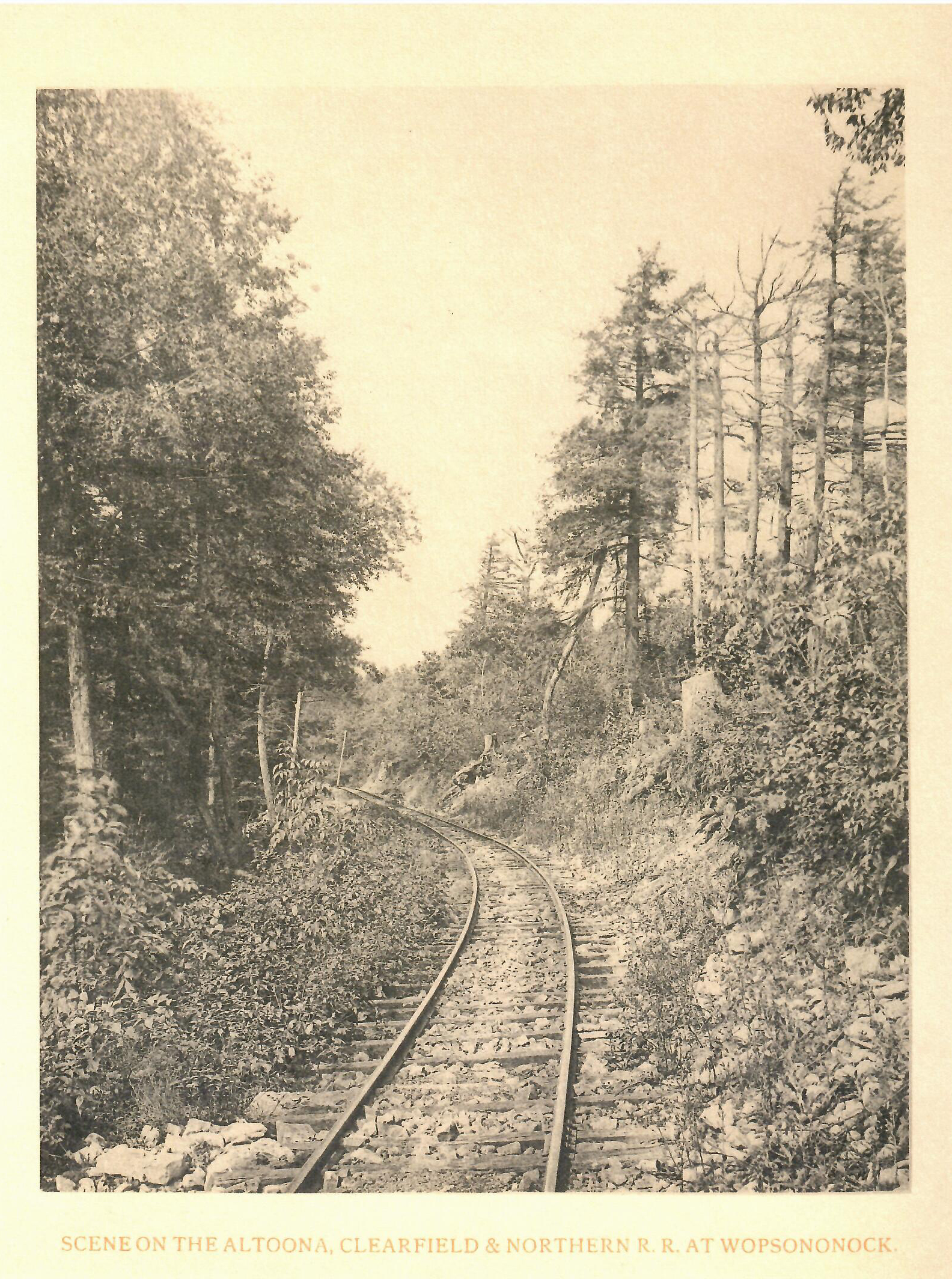
The Wopsononock Railroad was narrow-gauge until 1916, when a third rail was added, making it both narrow-gauge and standard-gauge.
A narrow-gauge railroad uses tracks where the distance between the rails (gauge) is less than the standard 4 ft 8.5 in), often around 3 feet, making them cheaper to build and ideal for difficult terrain like mountains, allowing for tighter curves, smaller tunnels, and lighter infrastructure. These railways were historically built for mining, logging, or rural areas where standard gauge wasn’t feasible.
Key characteristics:
Track width: Significantly narrower than standard gauge, typically 2 ft (600 mm) to 3 ft 6 in (1,067 mm).
Cost-effective: Lower construction costs due to less earthwork and smaller structures.
Terrain adaptability: Can navigate sharp curves and steep grades, perfect for mountainous regions.
Smaller equipment: Uses smaller locomotives and cars, though sometimes with less hauling capacity.
Common uses: Industrial: Serving mines, quarries, and plantations
Rural/Remote: Connecting isolated communities where traffic wouldn’t justify standard gauge.
Tourism: Many historic narrow-gauge lines.
East Broad Top Railroad (EBT) is a famous 3-foot narrow-gauge railroad. Located in Central Pennsylvania, it is recognized as the oldest surviving narrow-gauge common carrier railroad in the United States and was designated a National Historic Landmark in 1964.