
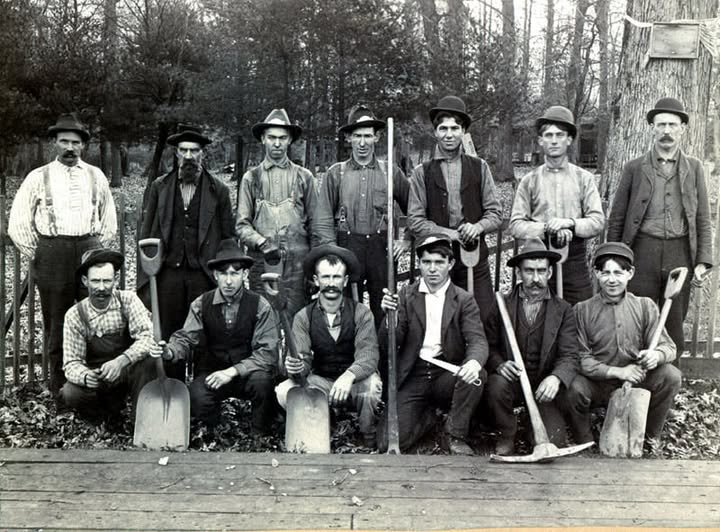
Significant development of Wopsononock Mountain—part of the Allegheny Mountains west of Altoona, Pennsylvania—began in the late 1880s. A group of local businessmen sought to capitalize on the mountain’s cooler summer climate and scenic vistas, as well as a newly discovered vein of rich coal in the northeastern corner of Cambria County near the village of Dougherty.
Before resort development began, a smaller Wopsononock Hotel already stood on the mountain. The Altoona Tribune of April 4, 1889, described the contrast between the original hotel and the new structure then under construction:
“Almost directly in front of the new house is the old Wopsononock hotel, which is dwarfed by the statelier building that is now being erected. This old building has been built for at least forty years, having been erected by Mr. Alex Holliday, of Hollidaysburg, who then owned the property, and for whom Mr. Thomas Keyes was tenant. Mr. Keyes afterward bought it, and the present company bought from him shortly before his death. The contrast between the two houses is most marked, yet both represent the period in which they were built.”
The centerpiece of the new resort community was the Wopsononock Hotel, which opened in early July 1889. This three-story, 60-room wooden structure featured a broad verandah along the entire front and on the left side, with Wopsononock prominently lettered across the façade. The resort offered numerous attractions, including a dance pavilion, a bowling alley, a baseball field, a shooting range, a merry-go-round, and lawn-tennis courts.
Tragically, a mountaintop forest fire on April 30, 1903, destroyed the hotel along with many of the cottages on Lookout Road. Damage to the hotel was estimated at $25,000, while insurance coverage amounted to only $2,500; as a result, the historic Wopsononock Hotel was never rebuilt.
Another notable attraction was the four-story observation tower known as Point View, located at the mountain’s edge. On clear days, visitors were said to be able to see six counties from its top platform. After the hotel’s destruction, maintenance of the tower ceased, and its condition steadily declined. It was torn down around 1911.
The Wopsy Railroad—originally a narrow-gauge line and converted to standard gauge in 1916—ran approximately fifteen miles from Juniata, near Altoona, westward to the Wopsononock plateau and onward to Dougherty in Cambria County. Service to the mountaintop began on June 11, 1891. Although the loss of the hotel in 1903 diminished passenger traffic, the railroad continued carrying picnickers and sightseers until financial difficulties forced its abandonment in 1919. At that time, most metal components were sold for scrap; today, only occasional wooden ties and narrow-gauge spikes can still be found along the old railbed. In 1923, some wooden buildings were dismantled and reused to construct the dance pavilion at Ivyside Park, now the site of Penn State Altoona.
The financial history of the Wopsy Railroad was turbulent, marked by frequent legal disputes between rival factions vying for control. Ownership changed hands many times, and the railroad operated under several different names over the years, including:
Altoona & Wopsononock; Altoona, Clearfield and Northern; Altoona & Beech Creek; Pittsburgh, Johnstown, Ebensburg & Eastern; Altoona, Juniata & Northern; and finally the Altoona Northern.