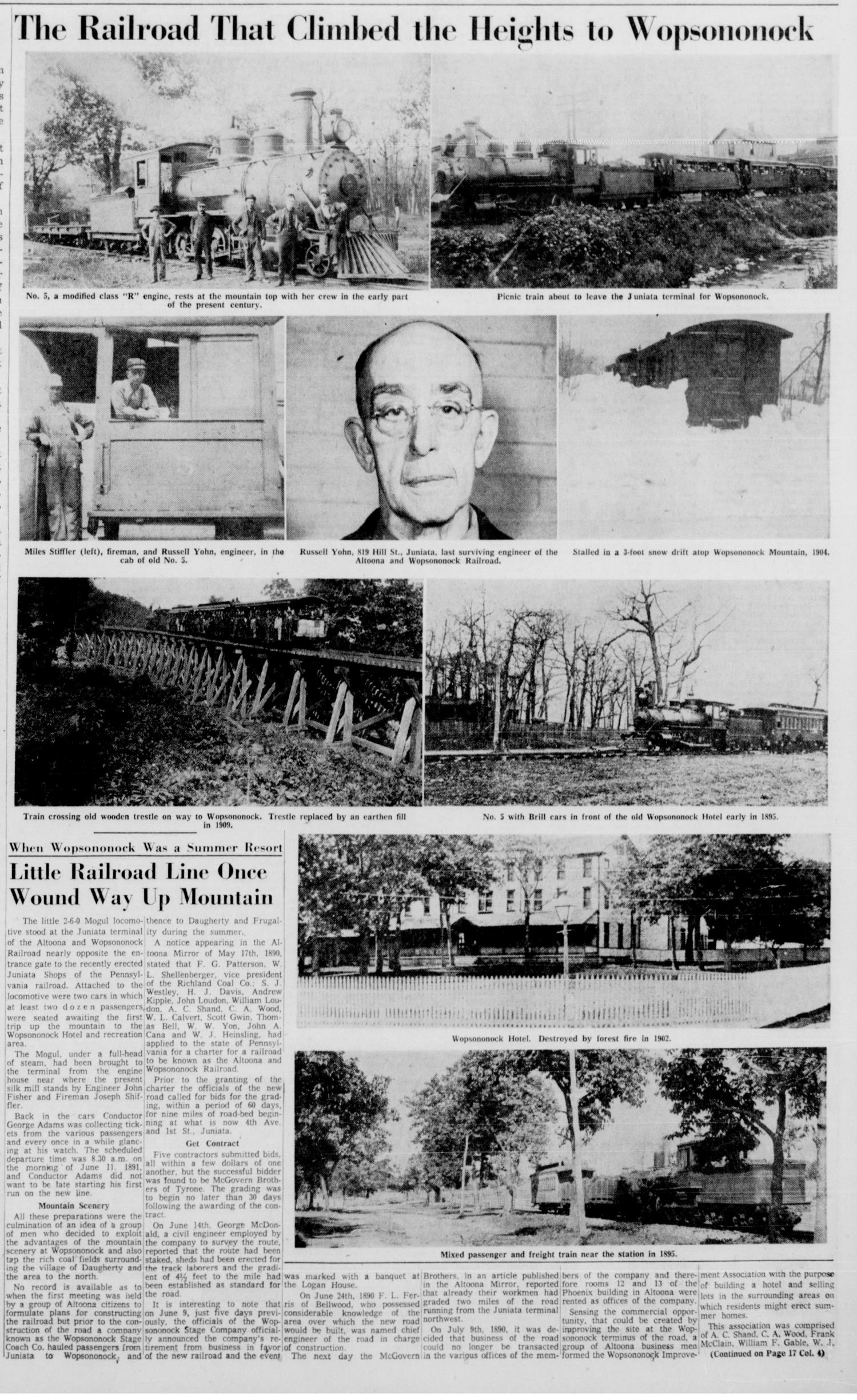
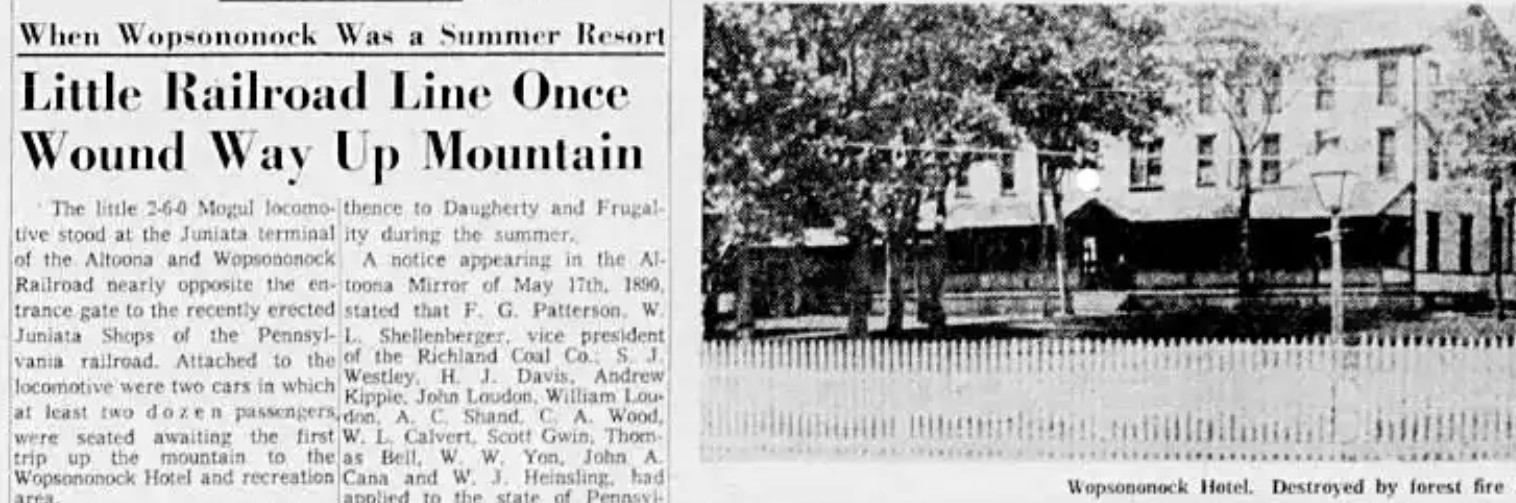
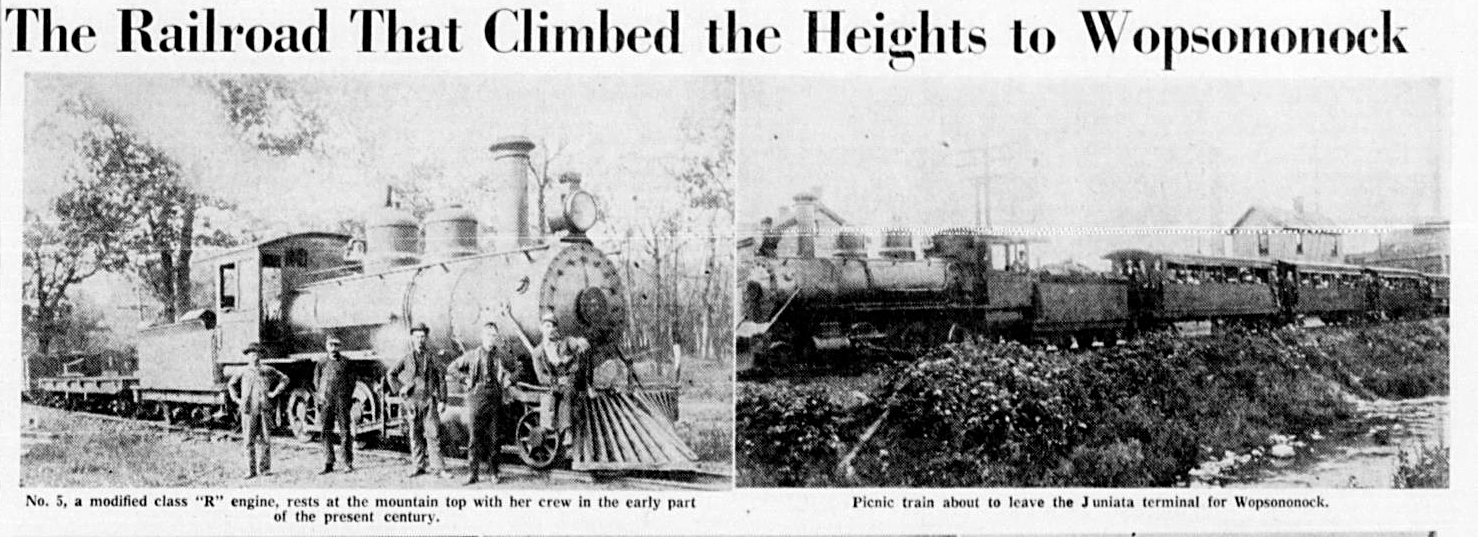
James Shafer, a longtime Altoona Mirror photographer with a deep personal interest in Wopsy history, produced a Wopsononock history that appeared in the Altoona Mirror on January 10, 1959.

In January 1959, Altoona Mirror photographer Jim Shafer wrote and published one of the most thorough and compelling histories of the Wopsononock Hotel and Railroad. His work captured not only the facts but the spirit of the resort and the narrow-gauge railroad that once brought summer visitors up the mountain from Altoona.

During the late 1970s, when I first began my own journey to uncover and preserve
the story of Wopsononock, Jim Shafer was incredibly helpful. He generously shared
his knowledge and insights, and I will always be grateful for the encouragement he
gave me as a young researcher.

To honor Jim Shafer’s, lasting contribution to local history, I have chosen to include his 1959 history here on this website. It remains one of the finest accounts ever written on this remarkable piece of Blair County’s past. I hope visitors will find his words as rich, engaging, and valuable as I did when I first read them decades ago.

Complete text:

When Wopsononock Was a Summer Resort

Little Railroad Line Once Wound Way Up Mountain

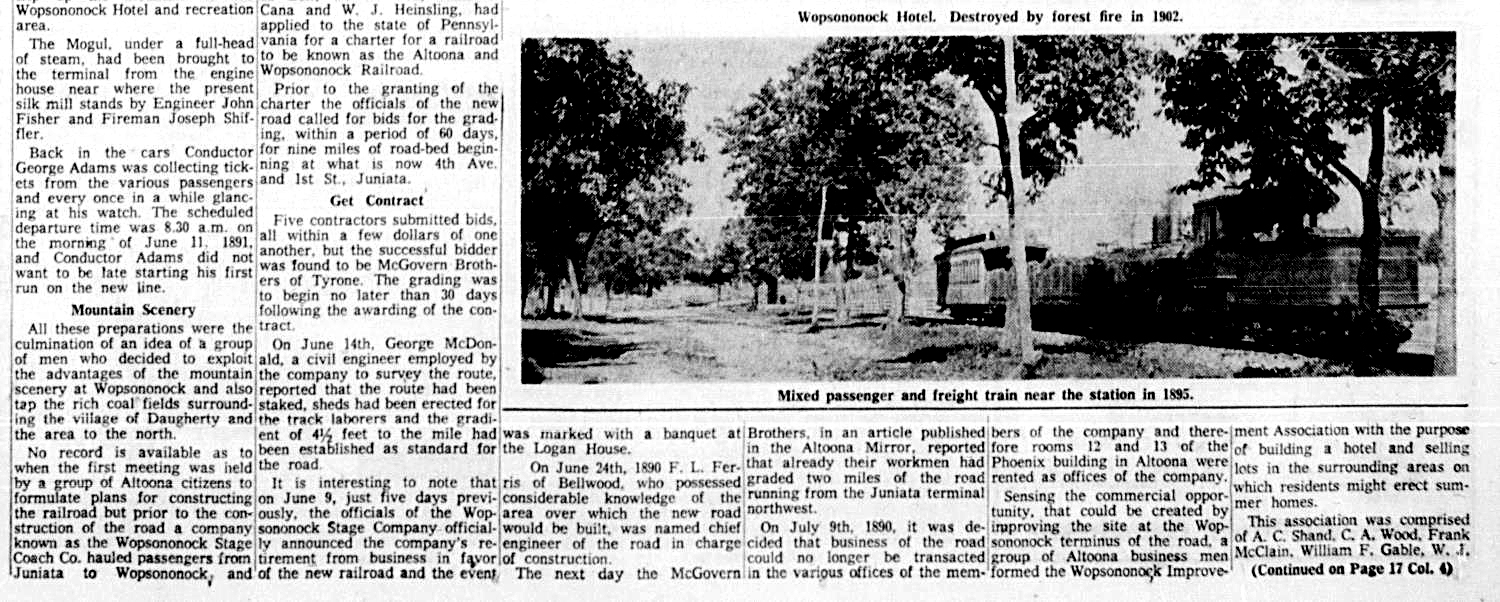
The little 2-6-0 Mogul locomotive stood at the Juniata terminal of the Altoona and Wopsononock Railroad, nearly opposite the entrance gate to the recently erected Juniata Shops of the Pennsylvania Railroad. Attached to the locomotive were two cars in which at least two dozen passengers were seated, awaiting the first trip up the mountain to the Wopsononock Hotel and recreation area.

     The Mogul, under a full head of steam, had been brought to the terminal from the engine house near where the silk mill once stood by Engineer John Fisher and Fireman Joseph Shiffler.

     Back in the cars, Conductor George Adams was collecting tickets from the various passengers and every once in a while, glancing at his watch. The scheduled departure time was 8:30 a.m. on the morning of June 11, 1891, and Conductor Adams did not want to be late starting his first run on the new line.

Mountain Scenery

     All these preparations were the culmination of an idea of a group of men who decided to exploit the advantages of the mountain scenery at Wopsononock and also tap the rich coal fields surrounding the village of Daughtery and the area to the north.

     No record is available as to when the first meeting was held by a group of Altoona citizens to formulate plans for constructing the railroad but prior to the construction of the road, a company known as the Wopsononock Stage Coach Co. hauled passengers from Juniata to Wopsononock and thence to Daugherty and Frugality (Cambria County) during the summer.

     A notice appearing in the Altoona Mirror of May 17th, 1890, stated that F. G. Patterson, W. L. Shellenberger, vice president of the Richland Coal Co.; J. Westley, H. J. Davis, Andrew Kipple, Joun Loudon, William Loudon, A. C. Shand, C. A. Wood, W. L. Calvert, Scott Gwin, Thomas Bell, W. W. Yon, John A. Cana and W. J. Heinsling had applied to the state of Pennsylvania for a charter for a railroad to be known as the Altoona and Wopsononock Railroad.

     Prior to the granting of the charter, the officials of the new road called for bids for the grading, within a period of 60 days, for nine miles of road-bed beginning at what is now 4th Ave. and 1st St., Juniata.

Get Contract

     Five contractors submitted bids, all within a few dollars of one another, but the successful bidder was found to be McGovern Brothers of Tyrone. The grading was to begin no later than 30 days following the awarding of the contract.

     On June 14th, George McDonald, a civil engineer employed by the company to survey the route, reported that the route had been staked, sheds had been erected for the track laborers and the gradient of 41/2 feet to the mile had been established as standard for the road.

     It is interesting to note that on June 9, just five days previously, the officials of the Wopsononock Stage Company officially announced the company’s retirement from business in favor of the new railroad and the event was marked with a banquet at the Logan House.

On June 24th, 1890, F. L. Ferris of Bellwood, who possessed considerable knowledge of the area over which the new road would be built, was named chief engineer of the road in charge of construction.
     The next day the McGovern Brothers, in an article published in the Altoona Mirror, reported that already their workmen had graded two miles of the road running from the Juniata terminal northwest.

     On July 9th, 1890, it was decided that the business of the railroad could no longer be transacted in the various offices of the members of the company and therefore, rooms 12 and 13 od the Phoenix building in Altoona were rented as offices of the company.

Sensing the commercial opportunity that could be created by improving the site at the Wopsononock terminus of the road, a group of Altoona businessmen formed the Wopsononock Improvement Association with the purpose of building a hotel and selling lots in the surrounding areas on which residents might erect summer homes.

     This association was comprised of
A. C. Shand, C. A. Wood, Frank McClain, William F. Gable, W. J. Heinsling, and Warren S. Lee.

On Aug. 4, 1890, the above company began the sale of lots in the area and announced plans to construct the hotel the following year. (The Wopsy Hotel on the mountain had previously been built and opened in early July 1889)  The sale of lots was a success and later in the year 1890, the improvement company established branch offices in Hollidaysburg and Tyrone.

     The railroad hit its first legal snag in August of 1890, when Carl Olmes, Frank Shepard and Clement Jaggard secured a temporary injunction halting construction across their lands. After a hearing in the Blair County courts, the injunction was not approved and once more, the construction proceeded toward the mountain top.

     Finally, on Dec. 19, 1890, after a two-foot fall of snow in the area, the McGovern Brothers announced that work for 1890 was terminated and that it would be resumed in the spring as soon as the weather permitted.

     The first annual meeting of the Altoona and Wopsononock Railroad was held in their offices at the Phoenix block on Jan. 13, 1891. Reports received at the meeting were that five miles of the road had been completed; two miles were yet to be graded and two miles were yet to be cleared of timber before grading could be started. Passenger car equipment was ordered from the New York Railway Co. and a locomotive was ordered from the Grant Locomotive Works of Patterson, N.J., and was of the 2-6-0 Mogul type.

     Considerable discussion was entered into at this time as to whether it was wise to make the road a narrow gauge one (3 feet between the rails) or whether it might have been wiser to adopt the standard Pennsylvania railroad gauge which might facilitate the passage of freight and coal over the line.

     As five miles of the rails had already been laid, it was decided to let the gauge stand at three feet.

     On March 16, 1891, work was resumed in building the road. It is interesting to note that excavation work was accomplished by the use of horse-drawn scoop shovels and black powder was used to clear the road when rocks or other obstacles were encountered.

 New Locomotive

     March 28, 1891, saw the directors order another locomotive from the Grant company, this one to be 10 tons heavier and to be used in freight and passenger traffic.

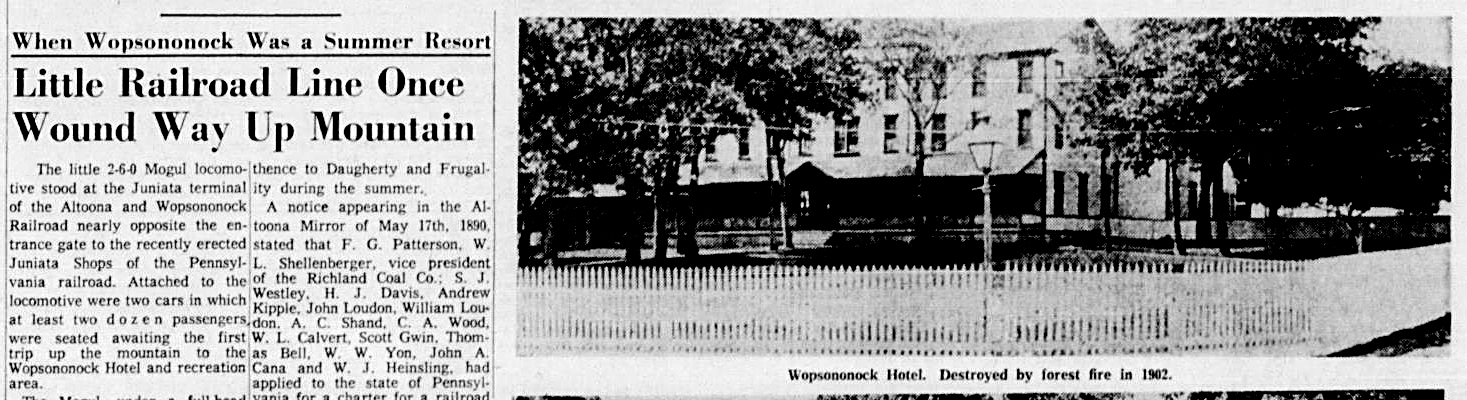
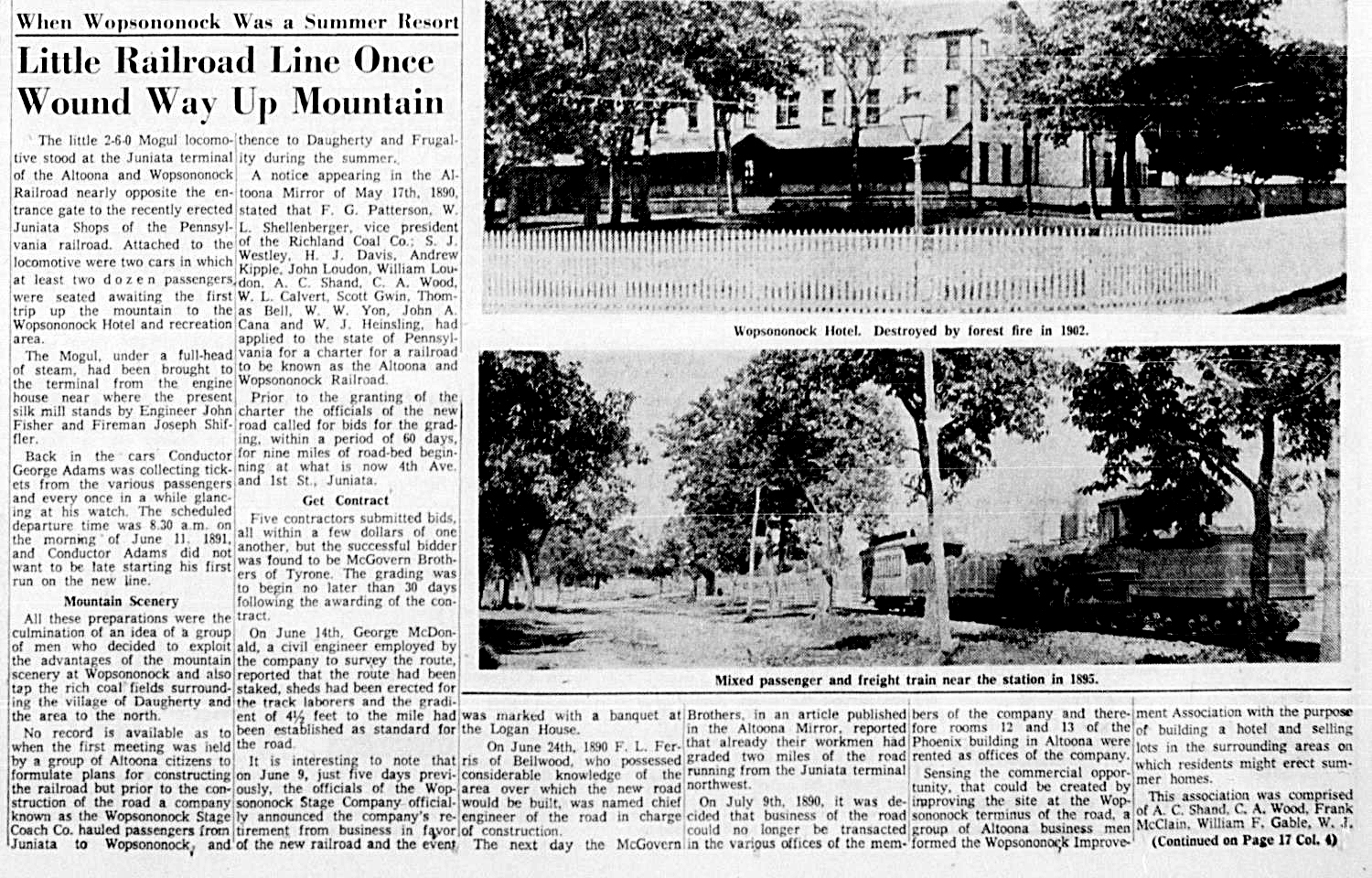
     Meanwhile, the Wopsononock Improvement Co. began the erection of the hotel. The first manager of the hotel is recorded as having been a Mr. O’Brien who was noted for the sumptuous dinners served at the hotel.

     The hotel was later purchased by Attorney Thomas Greevey, and in 1896, the manager was recorded as having been S. A. Lutz. The principal attraction at the mountain-top hotel in the summer of 1896 was the Trout family orchestra, composed of Mrs. Mitchell Trout and four members of her family.

     Attractions listed at the mountain-top in the year 1896 included: a photograph gallery, lawn tennis courts, playgrounds for the children, a lunch pavilion, a dancing platform and horse coach service to the nearby hamlet of Highland Flynn.

  Hotel Burns

     The hotel continued to serve the public until 1903, when it was destroyed by a mountain fire that burned over the area.

     In an account published in the Altoona Mirror of June 9, 1891, The general superintendent of the road, W. T. Forsythe, announced that the road had been completed to the mountain top and all that remained to be done was the construction of a “Y” for the turning of the trains and a short section of rails to be laid in front of the hotel. He also stated that the road would be opened for public travel on June 11, 1891. A week before, work trains had traversed the new road as had officials of the company in a private inspection tour.

     Despite the interest shown by citizens in the new road, there were only approximately two dozen people aboard the train for the first ride. This was believed due to the early hour of departure.

     Promptly at 8:30 a.m. on June 11, 1891, Conductor Adams gave the signal for departure and Engineer John Fisher eased the throttle forward to begin the trip up the mountain. The first trip was recorded as having taken 55 minutes to go up the mountain to Wopsononock and 51 minutes to return to Juniata.

     Evidently, the success of the first trip spread throughout the city for the afternoon train which was scheduled to leave Juniata at 2:30 p.m., had a full complement of passengers. This trip was also made in exactly the same time as the morning trip.

The Trip

     We are indebted to a Mirror reporter, whose name was not mentioned in the story, for an account of the afternoon trip. He described in detail the route of the road from the time it left Juniata until it reached the hotel at Wopsononock, dwelling on the various trestles needed to carry the road over the ravines and around the curve at Sandy Gap.

     Officials of the road at the time of its inaugural run were: President, F. G. Patterson; vice president, W. L. Shellenberber; treasurer, S. J. Westley; secretary, H. J Davis; general superintendent, W. T. Forsythe.

     The Mirror reporter also noted that at one point the grade reached four feet to every 100 feet, this being a gradient of 211 feet to the mile.

     He also reported that the last rail was being spiked into place in front of the hotel just before the train arrived at the station.

     It is interesting to note that all equipment including the coaches were painted in the same colors as Pennsylvania Railroad equipment.

     It was not until later in 1891 that the station at the Juniata terminus was built,  a small two-story frame building.

     Following the first day’s schedule, the President, F. G. Patterson announced the formal opening ceremonies would be held July 2, 1891.

Gala Day

     This must have been a gala day for a story reporting the opening mentioned the entire Altoona City Band making the trip on the road for a concert at Wopsononock and a private car being attached to the first morning train in which rode all the officials of the company.

     Records reveal that the trains made eight trips each way that day with the last train leaving Wopsononock at 10:45 p.m. following a display of fireworks.

     On Sept. 30, the Richland Coal Co. received its charter from the state of Pennsylvania and W. L. Shellenberger, vice president of the railroad was named president of the coal company.

     The directors of the Altoona and Wopsononock railroad lost no time in beginning an extension of the line to take care of traffic from the Richland Coal Co. mines and the very next day, McAleer Brothers Contracts received a contract to grade the road as far as Frugality.

     Cars to carry coal, which was the principal freight revenue for the remainder of the roads existence, were built in the company shops located near where the Juniata now stands. (1959) These were the first cars being built to the narrow gauge but in later years, converted to standard gauge. ( 4 ft 8.5 inches  )

     A copy of an old train schedule reveals that trains left Juniata at 7 a.m., 9:30 a.m., 2:30 p.m., and 6:20 p.m. Trains left Wopsononock station at 8:20 a.m., 11:20 a.m., 5:20 p.m., and 8:30 p.m. The schedule also notes that the round-trip fares from Juniata to Wopsononock were 30 cents.

Was Engineer

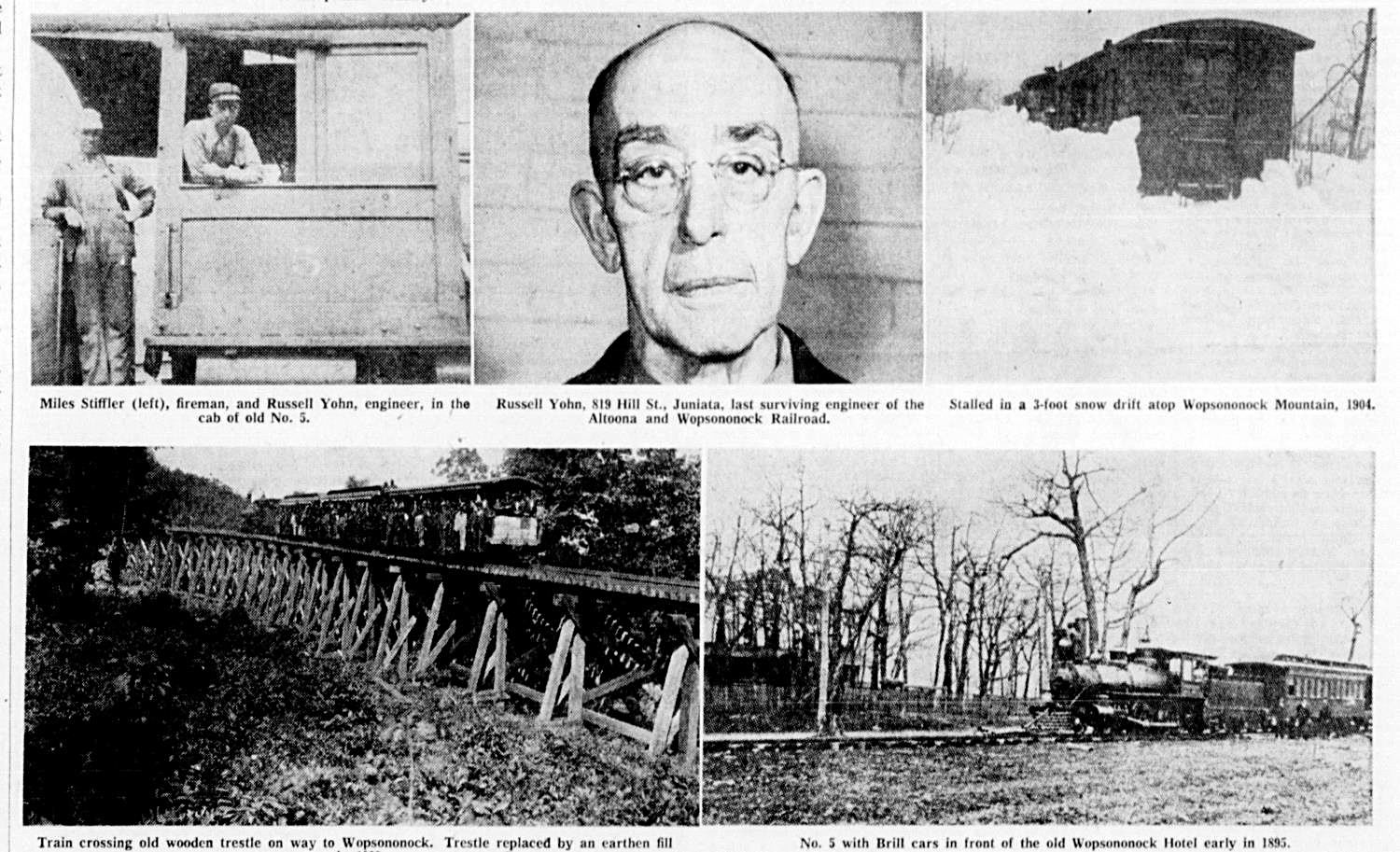
In checking for sources of information about the old railroad, the Altoona Mirror contacted Charles S. Cox, of Riggles Gap, for for many years conducted a dairy in Juniata. Mr. Cox immediately recalled that Russel Yohn of 819 Hill Street, Juniata, was a former engineer on the old railroad. Mr. Yohn first began service with the railroad in 1902 as a track hand and evidently quickly caught the railroading fever for in 1908, he became an engineer on the railroad.

     Mr. Yohn furnished much valuable information regarding the railroad.

     He recalled the engines owned by the road were numbered 1, 2, 3, and 4. The first three were classified as follows: No. 1 and No. 2 were 2-6-0 Moguls of the narrow gauge and No. 3, which was the pride of the road was a compound engine. It was the latter engine which was always shined to perfection and used to haul special trains of visiting officials. Later the company purchased a Shay geared-truck locomotive which was an oddity in this area due to the method used for propulsion.

     Records also show that after the roads conversion to standard gauge, two PRR engines, Class F-1 and numbered 7 an 8 were leased by the road.

     About the middle of the last decade, the road was leased to Samuel Landon of Pittsburgh and renamed the Pittsburgh, Johnstown, Ebensburg and Eastern Railroad. This sounds like a rather odd name for a road which apparently had no connection with any of the aforementioned places.  But it was Langdon’s hope to connect the road with a branch line leading from Frugality to Cresson and thence by the way of the Pennsylvania railroad right of way to Pittsburgh thus affording an outlet from the rich Cambria County coal fields to a large market at Pittsburgh.  

Litigation

     The lease to Langdon precipitated a litigation which lasted until 1910 when the road was purchased at a foreclosure sale by C. W. Moore, Andrew Kipple, W. J. Heinsling, and Warren S. Lee, with Mr. Lee being named president of the road. The road name was then changed  to the Altoona and Beech Creek Railroad. Most residents will remember the railroad as simply the Wopsy RR

To Standard Gauge

     The conversion of the road to standard gauge began in 1916 and Mr. Yohn recalled that he was assigned to go to the 12th. St. shops of the PRR in Altoona to take over one of the two F-1 class engines, which the road purchased from the Pennsylvania. He still has in his possession a railroad pass signed by G. W. Creighton giving him the authority to test the engine. The test run was made from Altoona to Tyrone and return.

     The Wopsy RR had several spur lines, Mr. Yohn stated; one running to a point near the present Forsht Lumber Yard where it made connection with the PRR. Another led to a point in Fairview where a coal dock was located.

     He recalled an incident that while taking a train up the mountain, he approached the trestle near Sandy Gap and as he did, a flock of 15 turkeys leisurely strolled across the tracks. He stopped the train and the passengers were afforded an excellent view of a flock of wild turkeys.

     The trestle mentioned above deteriorated to such an extent that in 1909, it was replaced with an earthen fill.

     In the spring of the year when the coal traffic began to fall off, the road then hauled sand and stone from the Shellenberger quarries near the top of the mountain. Employees of the quarry were housed in a long wooden shed located along the present road to Wopsononock. (in 1959)

     Mr. Yohn says that the original station at Wopsononock was torn down but the present station which still stands at the junction of the main road and the road which leads to the Lookout was built by Edmund Morris, a real estate promoter in 1916. Morris was president of the road in 1913.

     Mr. Yohn also recalled that under the Landon administration of the road, Langdon purchased two engines of the class “R” type from the Baldwin Locomotive                                                                                                                                                                                                                                                                                                                                                                                                                                                                                                                                                                                                                                                                                                                                                                                                                                                                                                                                                                                                                                                                                                                                                                                                                                                                                                                                                                                                                                                                                                                                                                                                                                                                                                                                                                                                                                                                                                                                                                                                                         Works and six passenger cars from the Brill Manufacturing Co.  Following the road’s conversion to standard gauge, the company purchased passenger cars from the Hancock and  G RR. These cars were painted green and the seats were finished in a green plush covering.

Tells of Fire

     In regard to the destruction of the Wopsononock Hotel by a forest fire in 1903, Mr. Yohn recalled that he was on duty at the time and went to the mountain top in time to see the hotel consumed by the flames. He stated that Mr. and Mrs. Casebeer were the managers of the hotel at the time and that Attorney Thomas Greevey of Altoona owned the hotel property.

     Trainmen who were employed on the railroad at the time of Mr. Yohn’s service as engineer included Art Stehley, passenger conductor; James Huber, freight conductor; George Gates, engineer; Joseph Gates, fireman; Miles Stiffler, fireman and Charles Wilt, brakeman.

     In the case of Charles Wilt, Mr. Yohn stated that when coal traffic got heavy in the wintertime, Mr. Wilt would apply for a job as brakeman and work until the spring when the coal traffic slacked off and then he would return to his greenhouse business in Greenwood where he was engaged in raising flowers for the commercial trade.

     At the beginning of the railroad, the cars used to haul coal were of from 12 to 15 ton capacity and were built in the company shops. Later when the road was converted to standard gauge, the company purchased hopper cars of from 25 to 35 ton capacity.

Was Fireman

     In concluding his reminiscences of the old railroad, Mr. Yohn related that Joseph Gates of 117 8th. Ave., Juniata, had worked as a fireman on the road and suggested the writer check with Mr. Gates about the road.

     Accordingly, the writer talked with Mr. Gates and he too was able to bring to light some long-forgotten facts about the road.

     Mr. Gates stated that he first began work on the road in 1913 and continued until 1917 when he entered the U.S. Army during World War I.

 Last Employee

     Upon his return from the service, Mr. Gates related that the road traffic had been reduced to one round trip per week between Daugherty mines and Juniata. He further related that his father, George Gates, was the last employee of the company before it was scrapped in 1920. The elder Gates for a number of years had served as engineer on the road and following the last run in 1919, he had been employed as a company watchman until the road was sold as scrap to an Altoona junk dealer.

     Mr. Gates described the conversion of the road from narrow to standard gauge stating that instead of tearing up one of the rails and relaying it to standard gauge, a third rail was added . This permitted the company to use both narrow and standard-gauge cars.

     Following the conversion to standard gauge, the company purchased about 50 hopper cars of 25 to 35 ton capacity.

     An interesting fact related by Mr. Gates was the method by which company officials blocked the seizure of the rolling stock during a period of litigation. The Fairview spur was classified as a separate division and all rolling stock was placed on that division.

In this manner, the officials avoided the order which gave one of the litigants the right to seize any rolling stock on the main line of the road.

     Mr. Gates confirmed the statement by Mr. Yohn that the Sigmund Morris Improvement Co. attempted to revive interest in the road by planning an electrification of the new real estate development at Wopsononock. This plan failed to materialize. Mr. Gated also related that the last manager of the road prior to its going out of existence was John R. McComis who later became a contractor in the city of Altoona.

     Few vestiges of the Wopsy railroad remain but at some points along the line, 

the roadbed of the old line may still be seen.

     In conclusion, the writer invites letters of information bearing on the history of the old road so that a complete history of the Wopsononock railroad may be maintained in the files of the Altoona Mirror.

-James M. Shafer